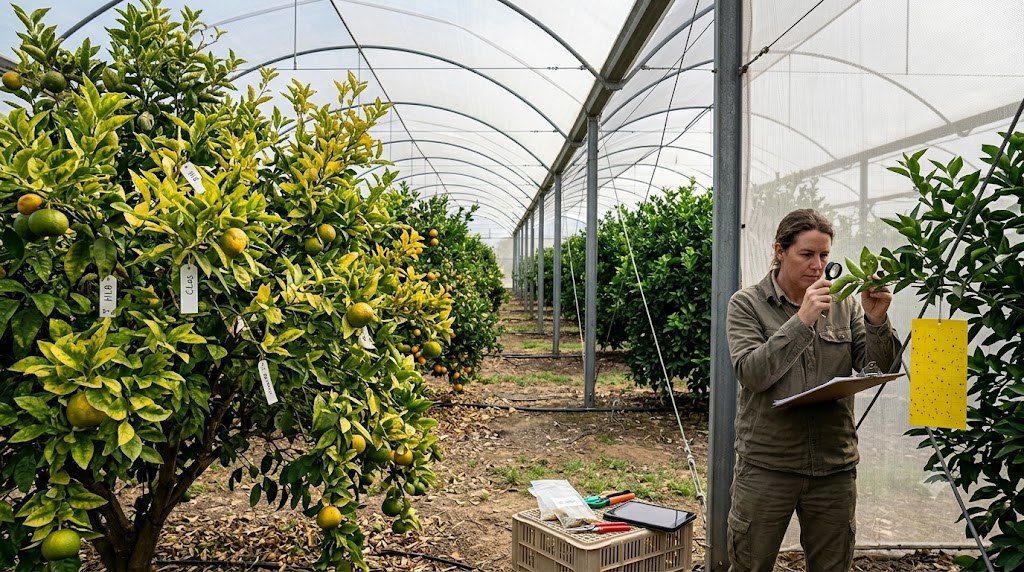
Phytopathology & Vascular Bacteriology Masterclass
A rigorous epidemiological investigation into Huanglongbing (HLB). We dissect Candidatus Liberibacter asiaticus phloem sieve occlusion, Asian citrus psyllid transmission kinetics, callose plugging mechanisms, CUPS protective screenhouses, and modern vascular antibiotic micro-infusion therapies.
Huanglongbing (HLB), derived from the Chinese term meaning ‘Yellow Dragon Disease’ and universally recognized in the Western hemisphere as Citrus Greening, is indisputably the most lethal and economically devastating disease currently facing global citriculture. Since its catastrophic introduction into the Western Hemisphere in the early 2000s, HLB has decimated commercial production across North and South America, reducing citrus acreage in premier production basins by over 70% and transforming orchard management into an intensive, multi-layered defensive battle for tree survival.
Taxonomy and Etiology of Candidatus Liberibacter asiaticus
The primary causal agent responsible for global HLB epidemics is Candidatus Liberibacter asiaticus (CLas), a fastidious, unculturable, phloem-limited bacterium belonging to the α-subdivision of Proteobacteria. CLas possesses a reduced bacterial genome (approximately 1.23 Mb) lacking key metabolic genes for standard amino acid synthesis and nucleotide synthesis, rendering it an obligate intracellular pathogen entirely dependent upon the host plant phloem sap and insect hemolymph for survival and replication.
Because the bacterium cannot be grown in pure synthetic culture, Koch’s postulates were fulfilled via molecular characterization, graft transmission, and vector transmission assays. The bacterium exhibits dimorphic cellular morphology: small, spherical coccoid bodies (0.2 to 0.4 μm diameter) and elongated, flexible rod-like cells (0.3 × 1.0 to 2.5 μm) bounded by a characteristic Gram-negative double-membrane envelope.
Phloem Xylem Anatomy & CLas Sieve Tube Occlusion
Huanglongbing (HLB), commonly designated as Citrus Greening, represents the most catastrophic phytopathological pandemic in global citriculture history. The disease is caused by unculturable, phloem-restricted, Gram-negative α-proteobacteria: Candidatus Liberibacter asiaticus (CLas) in Asia and the Americas, Ca. L. africanus (CLaf) in Africa, and Ca. L. americanus (CLam) in Brazil. CLas resides exclusively within the sieve tube elements of the citrus phloem.
Following transmission by the Asian Citrus Psyllid (Diaphorina citri), CLas bacteria circulate systemically, triggering profound host immune dysregulation. In response to bacterial presence, citrus sieve cells hyper-accumulate callose (β-1,3-glucan) around sieve pores and p-protein filaments. This callose plug completely occludes the sieve plates, choking the basipetal translocation of photosynthesized carbohydrates from mature canopy leaves to the root system. Deprived of sucrose, fibrous roots starve and decay (often shedding 30% to 50% of root mass before foliar symptoms manifest). Foliar symptoms appear as asymmetrical ‘blotchy mottle’ chlorosis, vein corking, premature fruit drop, and small, lopsided, bitter fruits with aborted seeds and inverted color inversion (stylar end remains green while stem end colors).
Psyllid Stylet Mechanics & Vector Inoculation
The Asian citrus psyllid (Diaphorina citri) vectors CLas during feeding probes on succulent emerging vegetative flushes (feather flush). The psyllid inserts its flexible stylet intercellularly into phloem sieve elements, acquiring bacterial cells within 30 minutes. Once acquired, CLas persists circulative-propagatively within the psyllid hemolymph and salivary glands for the insect’s entire lifespan.
CUPS Technology, Coordinated Sprays, and Thermal Therapy
Commercial survival in HLB-hyper-endemic citrus production basins (such as Florida and Brazil) relies on multi-tiered defensive architectures:
- Citrus Under Protective Screen (CUPS): High-value fresh-fruit cultivars (e.g., Honeybell, Tango, Cara Cara) are grown under engineered 40- to 50-mesh high-density polyethylene screenhouses. The microscopic mesh aperture (typically 0.6 mm) physically excludes psyllid entry, permitting completely HLB-free production with zero insecticide applications.
- Area-Wide Coordinated Chemical Sprays: Synchronized regional aerial and ground applications of neonicotinoids (imidacloprid, thiamethoxam) and pyrethroids during winter psyllid dormancy suppress overwintering adult populations before spring feather flush emerges.
- Oxytetracycline Trunk Injection: Modern regulatory approvals permit direct vascular micro-infusion of oxytetracycline hydrochloride directly into the secondary xylem trunk tissue using pressurized closed-circuit injector ports. Systemic upward translocation via the xylem transpiration stream diffuses into adjacent phloem, suppressing bacterial titers by over 90% and restoring fruit sizing and juice Brix.
| HLB Management Tactic | Mode of Action | Efficacy Horizon | Target Environment | Economic Investment |
|---|---|---|---|---|
| CUPS (Screenhouse Enclosures) | Total physical exclusion of Diaphorina citri | 100% vector prevention | Fresh market premium cultivars | Very High capital setup costs |
| Trunk Injection (Oxytetracycline) | Vascular antibiotic bacteriostatic suppression | Suppresses CLas titer for 12-18 mo | Bearing commercial groves | Moderate annual recurring expense |
| Coordinated Area Sprays | Chemical knockdown of adult psyllid vectors | Temporary vector population suppression | Regional agricultural blocks | Standard operational insecticide program |
| Kaolin Clay (Surround WP) | Hydrophobic particle film repels psyllid visual landing | Deters feeding probes by 70% | Organic & young non-bearing trees | Low to moderate foliar cost |
| Individual Protective Covers (IPCs) | Micro-mesh bags protecting individual young trees | Protects trees during critical 1-3 yr youth | New plantings in infected groves | Economical per-tree protection |
Biological Vector Suppression: Tamarixia radiata Parasitism and Classical Biocontrol
In integrated pest management (IPM) systems, chemical insecticide sprays against the Asian citrus psyllid (Diaphorina citri) are paired with the augmentative biological release of the specialist ectoparasitoid wasp Tamarixia radiata (Hymenoptera: Eulophidae). Originating in the native geographic range of the psyllid in Southern Asia, female T. radiata wasps locate fourth- and fifth-instar psyllid nymphs feeding on juvenile citrus flushes.
The female wasp deposits a solitary egg externally on the ventral surface of the psyllid nymph between the coxae. Upon hatching, the wasp larva pierces the host cuticle, feeding ectoparasitically on the nymph’s hemolymph and internal tissues. Within 8 to 12 days, the wasp consumes the host completely, spinning a silk cocoon inside the mummified nymph shell before chewing a circular exit hole to emerge as a reproductive adult. Concurrently, adult female wasps execute host feeding—puncturing young psyllid nymphs with their ovipositors to feed directly on exuded hemolymph—killing up to 500 additional nymphs per female. In residential citrus zones and organic groves where broad-spectrum pesticides are prohibited, augmentative releases of Tamarixia radiata achieve over 70% psyllid nymph mortality.
CRISPR/Cas9 Genetic Editing for HLB Immunity
Modern biotechnology aims to confer permanent genetic immunity against CLas by editing susceptibility genes (S-genes) in elite citrus cultivars. Targeting the citrus LOB1 (Lateral Organ Boundaries 1) promoter and antimicrobial peptide genes (such as spinach defensin peptides) via CRISPR/Cas9 ribonucleoprotein delivery produces transgenic-free clones displaying complete resistance to bacterial canker and suppressed CLas replication.
Breeding for Tolerance: US-897, OLL-8, and Antimicrobial Plant Peptides
While classic commercial sweet orange cultivars (Valencia, Hamlin) and grapefruits (Marsh, Ruby Red) are uniformly hyper-susceptible to Candidatus Liberibacter asiaticus (CLas), long-term field screening across global germplasm repositories has identified promising sources of natural tolerance among wild and hybrid Rutaceae. Australian finger lime (Citrus australasica) and certain complex trifoliate hybrids (such as US-897 and US-942) express endogenous stable antimicrobial peptides (SAMPs) that target and lyse CLas bacterial membranes.
These heat-stable, disulfide-rich peptides inhibit bacterial cell division without harming beneficial plant cellular organelles. Breeding programs led by the USDA-ARS and the University of Florida Citrus Research and Education Center (CREC) have developed advanced rootstock hybrids—such as US-942 (Sunki mandarin × Flying Dragon) and scion selections like OLL-8 (a vigorous somaclonal sweet orange variant)—that maintain dense fibrous root systems and productive fruit yields even when systemically infected with CLas titers.
Furthermore, physiological field research demonstrates that maintaining elevated root-zone density through intensive multi-pulse daily fertigation (delivering continuous balanced micro-doses of potassium, manganese, and zinc) prevents vascular starvation, enabling infected trees to sustain commercial economic fruit production for over a decade despite chronic bacterial infection.
Vector Feeding Disruption via Kaolin and Zinc Nanoparticles
Foliar applications of processed kaolin clay (Surround WP) combined with zinc oxide nanoparticles coat citrus leaves in a reflective, hydrophobic white matrix. High-speed video insect tracking confirms that kaolin particle films disrupt the visual and tactile host-selection behavior of adult psyllids, reducing egg oviposition on fresh flushes by over 80% while simultaneously lowering leaf temperatures during hot summer droughts.
Intensive Foliar Nutritional Therapy and Vascular Defense Biochemistry
In regions where Huanglongbing (Citrus Greening) has achieved endemic saturation and regulatory eradication is abandoned, commercial growers maintain productive canopies through intensive Enhanced Nutritional Programs (ENPs), historically pioneered by Bob Maury and refined by agricultural university trials. Because CLas-induced callose occlusion obstructs basipetal phloem transport, trees suffer localized severe nutrient starvation in young shoots and root tips.
Foliar nutritional therapy bypasses compromised root systems by delivering micro-chelated mineral nutrients, phosphites, and systemic acquired resistance (SAR) inducers directly through leaf cuticles:
- Potassium Phosphite (K3PO3): Phosphite ions (PO33-) are translocated systemically through both xylem and phloem. While phosphite does not substitute for orthophosphate fertilizer in plant metabolism, it acts as a potent elicitor, triggering host defense pathways: increasing the synthesis of phytoalexins, chitinases, and pathogenesis-related (PR) proteins that inhibit secondary fungal root rots (Phytophthora) in HLB-weakened trees.
- Salicylic Acid and SAR Elicitors: Exogenous foliar sprays of salicylic acid or its functional analog acibenzolar-S-methyl (ASM) induce systemic acquired resistance, stimulating the expression of defense genes that slow CLas bacterial titer multiplication within phloem sieve elements.
- Multi-Mineral Chelate Fortification: Monthly low-dose foliar applications combining zinc EDTA, manganese EDTA, boron, magnesium sulfate, and nickel (a critical cofactor for the urease enzyme) maintain high photosynthetic rates in blotchy chlorotic leaves, preventing early leaf shedding and sustaining fruit sizing.
Root Density Recovery via Slow-Release Oxytetracycline
Following trunk injection of oxytetracycline hydrochloride, quantitative PCR assays reveal a 95% reduction in CLas DNA copy numbers within 30 days. Concurrently, root minirhizotron imaging documents vigorous regeneration of new white fibrous feeder roots, increasing total root surface area by 40% within 4 months.
| Therapeutic Input | Chemical Form | Application Frequency | Target Physiological Mechanism | Expected Field Outcome |
|---|---|---|---|---|
| Oxytetracycline HCl | Aqueous vascular injection | Annual (post-harvest winter) | Inhibits CLas 30S ribosomal translation | Restores fruit yield and juice Brix |
| Potassium Phosphite | Foliar spray (2.5 L/ha) | 4-6 times per season | Stimulates host phytoalexins; suppresses Phytophthora | Protects root cortex from fungal rot |
| Zinc & Manganese EDTA | Foliar chelate (1.0 kg/ha) | At every vegetative feather flush | Cofactor for carbonic anhydrase and PS II | Greens up chlorotic blotchy mottle leaves |
| Acibenzolar-S-methyl | Foliar SAR inducer (50 g/ha) | Quarterly during growth flushes | Activates systemic acquired resistance genes | Slows bacterial titer multiplication |
| Soluble Humic Acids | Soil drip drench (20 L/ha) | Monthly through fertigation | Stimulates root tip auxin synthesis; chelates iron | Promotes fibrous feeder root regeneration |
Nanotechnology Delivery Platforms & Laser Photothermal Lysis in Phloem Tissues
To overcome the limitations of passive foliar sprays and invasive mechanical trunk drills, researchers are engineering targeted mesoporous silica nanoparticles (MSNs) and carbon dots to deliver antimicrobial molecules directly into phloem sieve tubes. Functionalized with phloem-homing peptide ligands, these 50-nanometer nanoparticles penetrate leaf stomata, traverse parenchymal cell walls, and selectively load into the sieve element-companion cell complex via plasmodesmata.
Once inside the phloem, the nanoparticles release antimicrobial compounds directly onto CLas bacterial biofilms. Concurrently, experimental trials exploring pulsed non-invasive laser photothermal therapy demonstrate that infrared laser wavelengths absorbed specifically by bacterial pigments induce localized micro-thermal lysis, destroying bacterial cells without damaging adjacent plant sieve plate membranes. These nanotechnology platforms represent the cutting-edge frontier of commercial citrus pathogen eradication.
In addition to therapeutic delivery platforms, commercial grove scouting relies on real-time field-deployable molecular diagnostics. Traditional central laboratory quantitative real-time PCR (qPCR) assays utilizing the 16S rDNA or las gene targets require days of turnaround time. Modern diagnostic protocols deploy isothermal Loop-Mediated Isothermal Amplification (LAMP) and portable handheld lateral flow strip cassettes. Field technicians extract crude leaf midrib sap in portable extraction buffers; under isothermal 65°C incubation, DNA amplification produces distinct colorimetric fluorescent shifts detectable by smartphone cameras within 30 minutes, allowing immediate identification and quarantine of early asymptomatic infected trees.
Economic Modeling and Grove Replacement Thresholds in HLB Endemic Zones
Managing commercial citrus under endemic HLB pressure requires a complete paradigm shift in agricultural economic modeling. In pre-HLB citriculture, orchards operated with long planning horizons: trees required minimal inputs during their first 3 years and remained productive for 30+ years with modest maintenance costs. Under severe HLB pressure, however, infected trees suffer progressive vascular decline, dropping 40% to 60% of their fruit prematurely and exhibiting stunted, bitter fruit with depressed juice Brix.
Economic survival demands maintaining aggressive tree density (600 to 1,000 trees/ha) combined with intensive input programs:
- Production Cost Realignment: Annual per-hectare management costs have surged from $2,500 (pre-HLB) to over $6,500 to $8,000, driven by bi-weekly psyllid insecticide sprays, constant foliar micronutrient feeding, and oxytetracycline injection programs.
- Grove Replacement Calculations: When CLas infection rates within a mature block exceed 80% and tree canopy dieback surpasses 40%, individual tree roguing becomes economically unviable. Growers must transition to block-wide bulldozing and replanting using CUPS enclosures or high-density plantings protected by individual protective covers (IPCs).
Agronomic Synthesis & HLB Management Imperatives
HLB is not a death sentence for citrus enterprises that adopt modern precision agronomy. Integrating physical exclusion screenhouses (CUPS), chemical and biological psyllid suppression, targeted trunk antibiotic therapy, and intensive daily micro-fertigation allows commercial growers to sustain high yields and exceptional juice quality.


