Regenerative Edaphology & Tree Physiology Masterclass
A comprehensive practical compendium covering winter trunk protection, Apple Replant Disease (ARD) disinfestation, leaf tissue mineral titration, Bitter Pit calcium transport kinetics, and aged hardwood mulch cycling.
The health, productivity, and longevity of a commercial fruit tree are deeply rooted in the physical and biological integrity of two critical anatomical zones: the lower trunk and root crown (the physical vascular bridge connecting roots to canopy) and the rhizosphere soil matrix (the subterranean reservoir of minerals, moisture, and microbial ecology). While canopy spraying and pruning receive immense focus, neglecting trunk protection or soil mineral balance frequently results in tree death, sudden trunk snap, or unmarketable physiological fruit disorders.
Anatomy of the Lower Trunk and Vascular Crown Transition Zone
The transition zone where the subterranean root system merges into the vertical aboveground trunk—the root crown or root collar—represents the most vulnerable structural hub of the entire tree. At the root crown, the conductive vascular tissues (outer phloem conveying photosynthesized carbohydrates downward from the canopy to roots, and inner xylem conveying water and minerals upward to leaves) are located mere millimeters beneath the thin outer bark periderm.
Because this zone is situated directly at the ground line, it is subject to continuous environmental and biological stresses: soil-borne moisture fluctuations, mechanical damage from tractor mowers and weed trimmers, herbicide spray drift, gnawing by winter rodents, and extreme temperature fluctuations. Maintaining clean, uninjured, well-ventilated root crowns is the premier prerequisite for long-term orchard productivity.
Trunk Biomechanics: Winter Sunscald (Southwest Injury) & White Latex Coating
In high-latitude and continental temperate climates, fruit tree trunks and lower scaffold limbs are highly vulnerable to catastrophic winter bark splitting known as Winter Sunscald or Southwest Injury. This injury does not occur during freezing nights; it is triggered by thermal fluctuations on bright, clear, sunny winter afternoons.
When the sun shines brightly on a freezing mid-winter day (ambient air temperature -5°C), the dark, unshaded bark on the south and southwest faces of the trunk absorbs intense shortwave solar radiation. Solar absorption warms localized bark cambial tissue up to 15°C to 20°C above freezing, stimulating dormant cambial cells to de-acclimate, hydrate, and break winter dormancy. When the sun drops behind the horizon in late afternoon, ambient temperatures plunge back down to -10°C within minutes. The unacclimated, hydrated cambial cells freeze rapidly; intracellular ice crystals rupture cell membranes, killing the vascular cambium and separating bark from secondary xylem, leaving wide, vertical necrotic wounds that invite wood-boring beetles and fungal cankers.
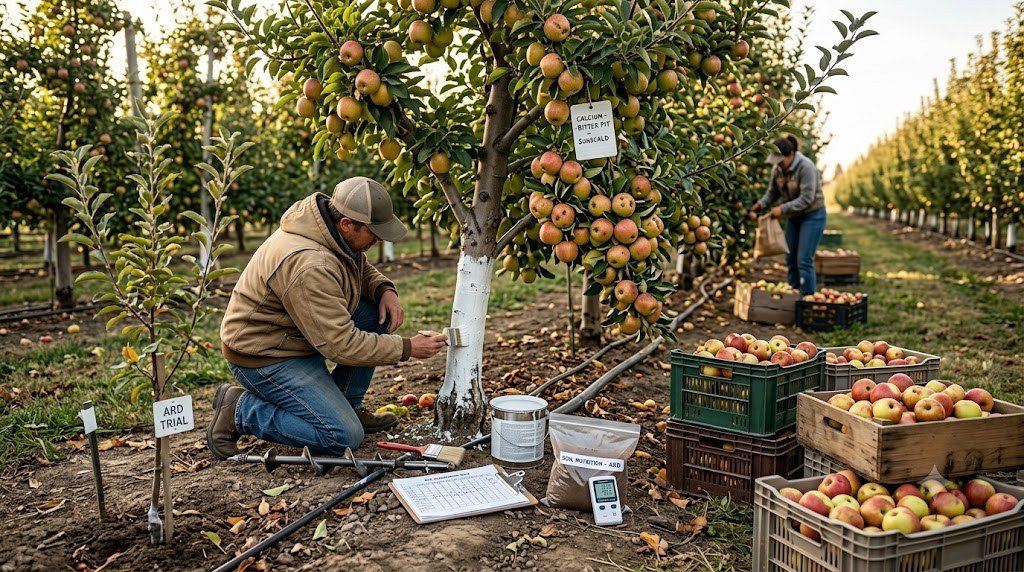
Commercial protection is completely non-chemical, economical, and physically effective: painting trunks from the soil line up to the first scaffold crotch with a 50:50 mixture of white interior water-based latex paint and water. The bright white coating reflects solar radiation, keeping bark surface temperatures within 1.0°C of ambient shade air, completely preventing premature cambial de-acclimation and southwest sunscald splitting.
Rodent & Vole Mechanical Girdling Guards
During winter snow cover, meadow voles (Microtus pennsylvanicus) and cottontail rabbits shelter beneath snowdrifts, gnawing away the tender living bark around tree trunks. Girdling the bark circumference destroys phloem transport, starving roots and killing the tree by mid-summer. Installing 40 cm tall, 1/4-inch galvanized wire mesh hardware cloth guards buried 5 cm into the soil protects young tree trunks.
Soil Regenerative Ecology: Organic Humic Substances & Mycorrhizal Bio-Priming
Maintaining high biological fertility and disease suppression in perennial orchard soils requires fostering a dense, diverse subterranean soil food web. Repeated broadcast applications of high-salt synthetic chemical fertilizers degrade soil structure, acidify soil matrices, and suppress native mycorrhizal fungal networks. Regenerative fruit tree care emphasizes continuous organic matter cycling:
- Aged Hardwood Arborist Woodchip Mulch: Applying a 10 to 15 cm layer of aged coarse arborist woodchips (coarse mix of shredded hardwood branches, bark, and leaves) along the tree drip line provides continuous physical and biological benefits. As fungal basidiomycetes decompose the high-lignin woodchips, they release complex humic and fulvic acids that elevate soil Cation Exchange Capacity (CEC), buffer soil moisture against extreme summer evaporation, and stimulate beneficial nematode predators that consume plant-parasitic root-lesion nematodes (Pratylenchus penetrans).
- Humic Acid & Bio-Fertilizer Drenching: Routine application of liquid potassium humate paired with compost teas rich in Bacillus and Trichoderma species creates a protective biological halo around expanding feeder roots, suppressing soil-borne damping-off fungi and accelerating phosphorus and micronutrient uptake.
| Trunk & Soil Intervention | Target Environmental Hazard | Timing & Frequency | Materials Required | Longevity & Impact |
|---|---|---|---|---|
| White Latex Trunk Painting | Southwest winter sunscald cambium rupture | Late Autumn (Annual on young trees) | 50% white interior latex + 50% water | Reflects solar radiation; lasts 1-2 years |
| Hardware Cloth Mesh Guards | Vole and rabbit subterranean bark girdling | At planting; permanent first 5 years | 1/4-inch galvanized steel mesh cylinder | Complete mechanical rodent exclusion |
| Arborist Hardwood Woodchip Mulch | Summer heat desiccation, weed competition | Spring application every 2-3 years | Coarse arborist woodchips (10-15 cm depth) | Builds topsoil organic matter; buffers temp |
| Winter Dormant Copper + Oil | Overwintering fungal spores and scale insects | Dormant season (late winter bud swell) | Copper hydroxide + 2% horticultural oil | Knocks down overwintering inoculum by 80% |
| Biological Mycorrhizal Inoculation | Poor phosphorus uptake, transplant shock | At planting directly in root furrow | Spore blend of Rhizophagus & Glomus | Establishes lifelong symbiotic nutrient uptake |
Apple Replant Disease (ARD) Complex and Anaerobic Soil Disinfestation (ASD)
When an aging commercial fruit orchard is removed and replanted immediately with the same or closely related fruit species, young trees frequently suffer from Apple Replant Disease (ARD) or Peach Replant Disease. Replant disease is not caused by a single pathogen; it is an edaphic biological syndrome induced by a parasitic pathogen complex comprising specific fungi (Rhizoctonia solani, Cylindrocarpon), oomycetes (Pythium ultimum, Phytophthora), and plant-parasitic root-lesion nematodes (Pratylenchus penetrans) that built to high populations over decades of previous monoculture.
Young trees planted into replant soils exhibit black, rotted feeder roots, stunted shoot growth (growing less than 15 cm in year one compared to normal 80+ cm), and delayed bearing. To combat replant disease without toxic synthetic chemical fumigants (such as methyl bromide or chloropicrin), modern pomologists utilize Anaerobic Soil Disinfestation (ASD):
- Carbon Amendment Incorporation: High-carbon organic amendments (e.g., wheat bran, brassica seed meal, or rice bran applied at 10 to 20 tons per hectare) are thoroughly tilled into the top 30 cm of soil.
- Plastic Tarping & Saturation: The amended soil is sealed beneath totally impermeable polyethylene film and irrigated to saturation via drip lines.
- Anaerobic Fermentation: Soil microbes rapidly consume available oxygen, triggering intense anaerobic fermentation. Anaerobic bacteria produce volatile fatty acids (acetic, propionic, butyric acids) and biocidal hydrogen sulfide that eradicate replant fungi, oomycetes, and nematodes within 4 to 6 weeks, rejuvenating soil biological fertility.
Resistant Geneva Apple Rootstocks for Replant Soils
Breeding programs at Cornell University / USDA-ARS developed the Geneva rootstock series (e.g., G.11, G.41, G.214, G.890). In addition to conferring dwarfing and fire blight resistance, Geneva rootstocks possess genetic tolerance to the ARD pathogen complex, establishing vigorous, productive trees even in heavily infested replant sites without chemical fumigation.
Diagnostic Leaf Mineral Titration and Bitter Pit Calcium Transport Kinetics
Maintaining high physiological fruit tree health requires moving beyond generic ground fertilization to precision diagnostic leaf tissue and fruitlet mineral titration. In commercial pomology, leaves are harvested for laboratory analysis 60 to 70 days post-petal fall (typically late July in the Northern Hemisphere), selecting mid-shoot leaves from current-season terminal growth.
The single most prevalent physiological disorder afflicting high-value apples (particularly ‘Honeycrisp’, ‘Braeburn’, and ‘Granny Smith’) is Bitter Pit, characterized by sunken, corky, bitter necrotic brown spots developing just beneath the fruit skin. Bitter pit is caused by localized calcium (Ca2+) deficiency in the fruit mesocarp during final sizing. Because calcium is an immobile cation that translocates strictly through the transpirational xylem stream, water travels predominantly to large, high-transpiring canopy leaves rather than low-transpiring fruitlets. If trees possess excessive vegetative vigor (induced by excess nitrogen or aggressive winter heading cuts), leaves siphon away calcium, starving developing fruit.
Commercial mitigation requires strict nutritional balancing:
- Target Tissue Ratios: In fruitlet tissue, the ratio of (Potassium + Magnesium) to Calcium: (K + Mg) / Ca must remain strictly below 25:1 to 30:1. Ratios exceeding 35:1 indicate severe bitter pit hazard.
- Foliar Calcium Chloride Regimes: Because soil-applied calcium moves too slowly to reach fruit in mid-summer, orchards deploy 6 to 10 sequential foliar sprays of technical-grade calcium chloride (CaCl2 at 0.3% to 0.5% concentration) spaced 10 to 14 days apart from petal fall until harvest. Calcium chloride penetrates directly through fruit lenticels, reinforcing pectin middle lamellae in fruit cell walls and reducing bitter pit incidence by over 80%.
Calcium Chloride Temperature & Humidity Warning
Never apply foliar calcium chloride sprays when ambient temperatures exceed 28°C (82°F) or under slow-drying, high-humidity conditions. Slow evaporation allows chloride ions to concentrate on leaf surfaces, causing severe chemical foliar phytotoxicity and marginal leaf scorch. Spray exclusively in early morning hours under fast-drying conditions.
| Mineral Element | Optimal Leaf Concentration (Dry Matter) | Deficiency Manifestation | Toxicity Threshold | Preferred Field Remediation |
|---|---|---|---|---|
| Nitrogen (N) | 2.2 – 2.6% | Pale leaves, small fruit, stunted shoots | > 2.8% (Soft fruit, bitter pit, delayed color) | Split spring fertigation; cease in late summer |
| Phosphorus (P) | 0.15 – 0.25% | Purple-bronze leaf margins, delayed bud break | > 0.40% (Induces zinc deficiency) | Monoammonium phosphate at early spring flush |
| Potassium (K) | 1.3 – 1.8% | Marginal leaf scorch, small pale fruit | > 2.2% (Antagonizes calcium and magnesium) | Potassium sulfate fertigation during fruit sizing |
| Calcium (Ca) | 1.4 – 2.0% | Bitter pit, cork spot, internal breakdown | Rare in field soils | Foliar CaCl2 sprays every 14 days directly to fruit |
| Magnesium (Mg) | 0.25 – 0.40% | Inverted V-shaped interveinal chlorosis on old leaves | > 0.60% | Foliar Epsom salts (MgSO4 at 1%) + dolomitic lime |
| Boron (B) | 35 – 50 ppm | Internal corking of fruit, blind nodes, blunt shoot tips | > 100 ppm (Marginal necrosis, shoot dieback) | Solubor foliar spray pre-bloom and post-harvest |
Autumn Foliar Zinc Urea Cocktails and Cold-Season Carbohydrate Partitioning
A sophisticated physiological management protocol in deciduous fruit tree care is the application of high-concentration Autumn Foliar Nitrogen-Zinc Sprays applied immediately prior to natural leaf senescence (typically October in the Northern Hemisphere, while leaves remain green and photosynthetically active).
Applying a concentrated foliar cocktail of 3% to 5% technical-grade urea combined with 0.5% chelated zinc delivers profound agronomic benefits:
- Direct Phloem Translocation to Storage Tissues: Foliar urea is rapidly absorbed by active mesophyll cells and converted into amino acids (glutamine, asparagine, and arginine). The tree actively translocates these nitrogenous reserves basipetally into the perennial wood of the trunk, major scaffold limbs, and root crown before leaf abscission. In early spring, when soil temperatures are too cold (<10°C) for active root mineral uptake, the tree remobilizes these stored nitrogen and zinc reserves directly into expanding blossom trusses and spur leaves, driving vigorous fruit set and early cell division.
- Defoliation & Pathogen Suppression: The high salt osmotic concentration of 5% urea accelerates uniform leaf abscission, clearing the canopy before early autumn snowstorms. Furthermore, fallen leaves coated with 5% urea stimulate intense saprophytic bacterial decomposition on the orchard floor. The elevated nitrogen content accelerates microbial breakdown of leaf cuticles, completely destroying overwintering pseudothecia of Venturia inaequalis (apple scab) and suppressing spring ascospore discharge by over 80%.
Post-Senescence Caution: Timing Is Critical
Autumn foliar urea must be applied when leaves are mature but still dark green and functional (roughly 2 to 3 weeks before expected natural frost). Applying too early (late summer) stimulates unwanted autumn vegetative flushes that cannot harden for winter; applying too late (after leaves yellow) prevents nitrogen absorption and phloem translocation into woody storage tissues.
Soil Cation Saturation Ratios and Spring Calcium Nitrate Fertigation
While foliar calcium chloride sprays target the fruit directly, establishing proper baseline soil calcium saturation forms the foundation of tree vascular health. In diagnostic soil cation exchange tests, the Base Saturation Percentage of Calcium (Ca%) should ideally represent 65% to 75% of total soil exchange capacity, with Magnesium representing 10% to 15% and Potassium representing 3% to 5%.
In acidic or sandy orchard soils where native exchangeable calcium is depleted, spring fertigation programs deploy greenhouse-grade soluble calcium nitrate (5Ca(NO3)2 · NH4NO3 · 10H2O) delivered through drip systems during the 6-week window between petal fall and early fruit sizing. Delivering calcium ions directly into the active root transpiration stream provides the building blocks for new root cell division and xylem vessel formation, enhancing drought resistance and reinforcing overall tree structural integrity.
Agronomic Synthesis & Trunk Care Master Principles
Protecting tree investments requires painting trunks with 50% white latex paint before winter frosts, installing 1/4-inch hardware cloth rodent guards, applying sequential foliar calcium chloride sprays to prevent bitter pit, and deploying autumn 5% urea-zinc cocktails to prime spring flower vigor.


