Specialty Citrus Genetics & Canopy Biomechanics
An in-depth pomological guide to commercial citrus varieties and canopy maintenance. We investigate cold-dependent anthocyanin synthesis in Blood Oranges, lycopene accumulation in Cara Cara Navel, acid citrus physiology in lemons and limes, and tractor-mounted mechanical hedging architectures.
The global citrus industry encompasses a vast diversity of cultivars bred and selected across centuries of botanical selection. From sweet dessert oranges (Citrus sinensis) and rich easy-peel mandarins (Citrus reticulata) to vibrant pigmented blood oranges, lycopene-rich navels, and high-acid processing fruits like lemons (Citrus limon) and limes (Citrus aurantiifolia / C. latifolia), each cultivar group exhibits distinct phenological rhythms, biochemical pigment pathways, and canopy pruning responses.
Taxonomic Diversity and Origin of Commercial Citrus Groups
Molecular genomic sequencing has revealed that all modern commercial citrus cultivars are derived from hybridization events among three ancient ancestral wild species native to South and Southeast Asia:
- Citrus maxima (Pummelo): The largest of all citrus fruits, native to the Malaysian archipelago. Endowed modern hybrids with thick albedo, large juice vesicles, and high heat tolerance. Hybridized with sweet orange to produce the commercial grapefruit (Citrus paradisi).
- Citrus medica (Citron): An ancient sacred fruit originating in the foothills of the Himalayas. Features an enormous fragrant rind with minimal juice. Parent to commercial lemons and limes.
- Citrus reticulata (Mandarin): A small, sweet, loose-skinned ancestral fruit from southern China. Contributed high soluble sugars, intense aroma, and easy-peeling flavedo characteristics to all modern clementine, tangor, and sweet orange cultivars.
Through centuries of natural mutation and targeted breeding, cross-pollination among these three ancestral patriarchs gave rise to the secondary hybrid complexes that dominate global commercial fruit aisles today.
Anthocyanin vs. Carotenoid Pigment Kinetics: Blood Oranges vs. Cara Cara
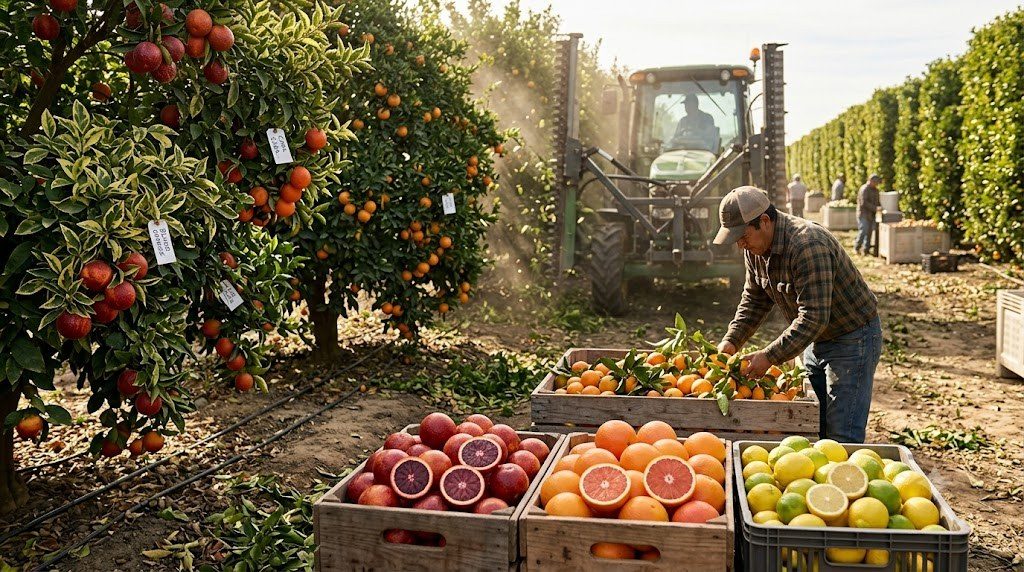
The internal flesh pigmentation of specialty citrus represents a fascinating divergence in secondary plant biochemistry. Conventional sweet oranges and mandarins derive their vibrant yellow and orange colors from lipophilic carotenoids (primarily β-cryptoxanthin, lutein, and violaxanthin) biosynthesized in chromoplasts. In the pink-fleshed Cara Cara Navel (a spontaneous bud mutation of the Washington Navel), an enzymatic bottleneck blocks the conversion of lycopene into downstream cyclic carotenes. Consequently, Cara Cara accumulates high concentrations of lycopene (the same linear carotenoid found in tomatoes and watermelons), conferring a deep ruby-pink hue that develops independently of ambient temperature.
In stark contrast, Blood Oranges (e.g., ‘Moro’, ‘Tarocco’, ‘Sanguinello’) owe their dramatic crimson and violet flesh to water-soluble anthocyanins (predominantly cyanidin-3-glucoside), which reside inside the acidic central vacuoles of juice vesicle cells. Anthocyanin biosynthesis in citrus is transcriptionally regulated by the Ruby Myb transcription factor, which is strictly cold-dependent. To trigger robust anthocyanin synthesis, developing fruit must experience sharp diurnal temperature fluctuations during late autumn and winter, requiring night temperatures between 2°C and 8°C coupled with warm, sunny days. Without sufficient chilling hours, blood oranges grown in warm, humid tropical climates remain visually indistinguishable from standard blond oranges.
Chilling Hour Requirements for Tarocco Pigmentation
The premier Italian blood orange ‘Tarocco’ requires between 200 and 300 cumulative chilling hours (< 8°C) to synthesize its peak anthocyanin profile. Harvesting Tarocco early in warm climates produces pale, unpigmented juice; delaying harvest until mid-winter cold snaps unlocks deep crimson pigmentation and superior antioxidant activity.
Pruning Biomechanics: Hedging, Topping, and Water Sprout (Sucker) Sanitation
Unlike deciduous fruit trees that require severe annual dormant pruning to stimulate new fruiting wood, mature citrus trees are evergreen and store large quantities of non-structural carbohydrates in their permanent branches and leaves. Excessive manual pruning removes active carbon sources, inducing vigorous vegetative regrowth that depresses fruit set for several seasons. Consequently, commercial citrus pruning is governed by disciplined mechanical maintenance:
- Mechanical Hedging (Row Profiling): Tractor-mounted multi-saw booms hedge the sides of tree canopies at a 10- to 15-degree inward taper (trapezoidal canopy profile). This angled canopy hedge prevents upper branches from shading lower limbs, maintaining active photosynthetic leaves and fruiting skirts down to 60 cm above ground. Hedging maintains clear 2.0-meter equipment alleys for tractors and sprayers.
- Mechanical Topping: Periodic horizontal topping at 3.5 to 4.2 meters caps tree height, ensuring effective chemical penetration from air-blast spray nozzles and keeping fruit within harvesting reach.
- Manual Skirting and Water Sprout Removal: Hand pruning crews skirt trees by removing all branches originating below 60 cm from the ground. Skirting eliminates soil-splash infection of brown rot (Phytophthora syringae), prevents ant pathways into the canopy, and improves herbicide application safety. Concurrently, vigorous vertical water sprouts (‘bull wood’) originating from interior scaffold limbs are excised at their base to preserve canopy light penetration.
| Cultivar Group | Key Commercial Varieties | Flesh Pigment Basis | Chilling Dependency | Pruning & Hedging Protocol |
|---|---|---|---|---|
| Blood Oranges | Moro, Tarocco, Sanguinello | Anthocyanins (Cyanidin-3-glucoside) | Strict (requires 2-8°C night drops) | Light interior thinning to maximize light and cold exposure |
| Pink Navels | Cara Cara Navel | Lycopene (Non-cyclic carotenoid) | None (develops in warm climates) | Standard mechanical hedging and skirting |
| Clementines / Mandarins | W. Murcott, Tango, Nadorcott | β-Cryptoxanthin (Carotenoid) | Moderate (enhances exterior skin color) | Requires annual skirting and selective window pruning |
| Acid Citrus (Lemons/Limes) | Eureka, Lisbon, Bearss Lime | Chlorophyll / Carotenoid trace | None (continuous year-round bloom) | Aggressive mechanical topping to manage extreme apical vigor |
| Grapefruit | Ruby Red, Rio Red, Star Ruby | Lycopene & β-Carotene | None (high heat required for Brix) | Hedging to maintain wide alleys; skirting to prevent thrip scarring |
Fungal Blight Epidemiology: Alternaria Brown Spot and Post-Bloom Fruit Drop (PFD)
Cultivar selection profoundly influences the disease management calendar in commercial citrus groves. High-value specialty hybrids, particularly Minneola Tangelo, Murcott, and Dancy Tangerine, are hyper-susceptible to Alternaria Brown Spot caused by the fungal pathogen Alternaria alternata (tangerine pathotype). The fungus produces a host-selective ACT-toxin that selectively ruptures cell plasma membranes in young expanding leaves and fruitlets, causing necrotic brown halos and devastating premature leaf and fruit abscission.
Similarly, in humid subtropical climates, rainfall during spring bloom triggers epidemic outbreaks of Post-Bloom Fruit Drop (PFD) caused by Colletotrichum acutatum. Fungal spores infect open citrus blossom petals, producing peach-to-orange colored necrotic lesions. As petals wither, fungal enzymes trigger abscission of young fruitlets, leaving persistent, lignified calyces attached to twigs (known as ‘buttons’). These buttons remain attached to branches for years as sterile reminders of crop failure. Controlling both pathogens demands predictive weather modeling and timed prophylactic applications of strobilurin fungicides (e.g., pyraclostrobin) alternated with copper hydroxide during early petal push.
Fruitlet Abscission Dynamics (June Drop)
Citrus trees naturally produce hundreds of thousands of flowers, yet less than 1% to 2% mature into harvestable fruit. Physiological fruitlet drop occurs in two distinct waves: immediately following petal fall (abscission of unpollinated or weak ovaries) and late spring (‘June drop’), driven by hormonal competition for photosynthetic sucrose between rapidly growing shoots and swelling fruitlets.
Post-Harvest Degreening Kinetics, Ethylene Biochemistry, and Cold Quarantines
For early-season fresh-market citrus (such as early Fallglo tangerines or Navel oranges), fruit often reaches acceptable internal maturity (satisfying legal minimum sugar-to-acid ratios) while the external peel (flavedo) remains green. In citrus, external peel color change is governed primarily by ambient temperature: cool autumn nights (< 13°C) degrade chlorophyll and trigger carotenoid synthesis. In warm subtropical growing regions, early fruit must undergo commercial ethylene degreening in specialized climate-controlled curing rooms.
During commercial degreening, freshly harvested fruit is exposed to continuous low concentrations of gaseous ethylene (1.0 to 5.0 ppm C2H4) at 20°C to 22°C with 90% to 95% relative humidity and continuous air circulation (venting CO2 below 0.2%). Ethylene binds to intracellular ethylene receptors, triggering rapid de novo synthesis of chlorophyllase enzymes, which catabolize green chlorophyll pigments to reveal underlying orange and yellow carotenoids within 48 to 72 hours. Maintaining temperatures strictly below 25°C is critical; higher temperatures accelerate fruit respiration, soften fruit rinds, and promote stem-end rots caused by Diplodia natalensis.
For international export across quarantine zones threatened by the Mediterranean fruit fly (Ceratitis capitata), citrus shipments must undergo certified Cold Treatment (CT). Under USDA-APHIS protocols (T107-a), fruit pulp temperatures must be maintained continuously at 1.1°C (34°F) or below for 14 consecutive days during ocean transit. This extreme cold sterilizes all fruit fly eggs and pupae without chemical fumigants, ensuring market access while preserving crisp vesicle turgidity.
Pre-Harvest Gibberellic Acid (GA3) Sprays for Peel Longevity
Foliar applications of gibberellic acid (GA3 at 10 to 20 ppm) applied during the late-summer green fruit stage delay flavedo senescence, retain peel turgidity, and prevent rind creasing. This practice extends the on-tree harvesting window for late-season Valencia oranges by 4 to 8 weeks without loss of fruit quality.
Peel Essential Oil Glands, Flavedo Terpene Chemistry, and Windbreak Fluidics
The outermost layer of the citrus pericarp, the flavedo, is densely embedded with spherical, lysigenous essential oil glands (schizolysigenous cavities) synthesized within the subepidermal parenchyma. These oil cavities contain high-value aromatic secondary metabolites, consisting of over 90% to 95% monoterpenes—overwhelmingly d-limonene—along with oxygenated terpenes (linalool, citral, geraniol, α-terpineol) and sesquiterpenes (valencene in sweet orange, nootkatone in grapefruit).
In addition to defining varietal aroma, these essential oils serve as a critical biochemical defense shield against herbivorous insects and fungal pathogens. However, the physical structure of these oil glands presents major vulnerabilities to mechanical wind injury:
- Wind-Scarab Rubbing & Oleocellosis: In high-wind coastal or desert regions, wind speeds exceeding 25 km/h cause developing fruit to rub violently against abrasive branches, thorns, and leaves. Mechanical abrasion ruptures fragile oil glands, releasing volatile citrus peel oil directly onto the fruit epidermis. Because citrus peel oil is highly phytotoxic to living epidermal cells, the released oil destroys the surrounding green flavedo tissue, producing permanent, unsightly, dark brown sunken necrotic blemishes known commercially as oleocellosis or wind scar.
- Windbreak Engineering Fluidics: Commercial citrus orchards prevent wind scarring through engineered living or artificial windbreaks. A properly designed windbreak possesses approximately 40% to 50% optical porosity (permeability). Solid walls create turbulent downward eddies on the leeward side; porous windbreaks allow filtered laminar air passage, reducing downwind surface wind speeds by 50% to 70% across a distance equal to 10 to 15 times the height of the windbreak. Integrating evergreen windbreaks (such as Casuarina cunninghamiana or Italian Cypress) elevates marketable grade-A fruit packout by over 35%.
Harvesting Turgidity and Oleocellosis Risk
Never harvest fresh citrus in early morning hours when fruit is saturated with dew and oil glands are under high turgor pressure. Turgid oil glands burst under the slightest fingertip pressure from pickers. Delay harvesting until late morning when solar transpiration relieves fruit turgor pressure below 3.0 kg/cm² (measured via pressure tester).
| Citrus Species | Primary Essential Oil Monoterpene | Key Character Impact Compound | Oil Gland Depth in Flavedo | Wind Scar Vulnerability |
|---|---|---|---|---|
| Valencia Sweet Orange | d-Limonene (92 – 95%) | Valencene, Octanal | Medium (250 – 350 μm) | Moderate |
| Lisbon / Eureka Lemon | d-Limonene (65 – 70%) | Citral (Neral + Geranial) | Shallow (180 – 250 μm) | Severe (highly sensitive to oleocellosis) |
| Marsh Grapefruit | d-Limonene (88 – 92%) | Nootkatone, β-Pinene | Deep (400 – 600 μm) | Moderate |
| W. Murcott Mandarin | d-Limonene (90 – 93%) | α-Sinensal, Linalool | Thin, fragile epidermis | High (tender peel easily abraded) |
| Bearss / Persian Lime | d-Limonene (55 – 65%) | β-Pinene, γ-Terpinene | Very shallow, dense glands | Severe (rapid oil blemish discoloration) |
Controlled Atmosphere (CA) Storage Protocols for Fresh Export Citrus
Maintaining long-distance export quality for premium mandarins and navel oranges requires precision Controlled Atmosphere (CA) ocean reefer container logistics. In standard cold air storage, citrus fruits continue aerobic respiration, consuming internal organic acids and sugars. By adjusting the storage atmosphere to 3% to 5% O2 and elevating CO2 to 2% to 3% at 5°C to 8°C with 90% relative humidity, fruit respiration rates are suppressed by over 40%.
This metabolic suppression delays rind senescence, retards button abscission (preserving green calyces), and prevents stem-end rots without generating anaerobic ethanol off-flavors. Combining CA storage with wax coatings formulated from carnauba and shellac maintains glossy cosmetic market appeal and fresh turgid fruit vesicles across 45-day international ocean transit voyages.
Integrated Juice Chemistry: Soluble Solids, Acidity Ratios, and Limonin Bitterness
In both fresh market and processing citriculture, legal maturity and consumer eating quality are defined by juice biochemistry, specifically the ratio of Total Soluble Solids (TSS, measured as °Brix) to Titratable Acidity (TA, expressed as citric acid equivalent). Brix measures dissolved sugars (sucrose, glucose, fructose), while titratable acidity measures organic acids (primarily citric acid with minor malic and succinic acids):
- Maturity Ratio Dynamics: As citrus matures on the tree, Brix gradually increases while organic acids are catabolized via respiration, causing the Brix:TA ratio to climb. For sweet oranges, standard commercial export requires a minimum ratio of 8.0:1 or 9.0:1; premium mandarins achieve peak sensory palatability at ratios between 12.0:1 and 15.0:1.
- Delayed Bitterness & Limonin Dynamics: Navel oranges (such as Washington Navel) contain non-bitter limonoate A-ring lactone within intact fruit cells. When navel oranges are mechanically juiced for processing, the disrupted cell vacuoles release acidic juice, catalyzing the rapid conversion of the non-bitter precursor into intensely bitter limonin within hours. Consequently, Navel oranges are marketed exclusively as fresh table fruit, while Valencia oranges (which synthesize negligible limonoate precursors) serve as the premier global standard for commercial pasteurized juice processing.
Agronomic Synthesis & Cultivar Vision
Capitalizing on specialty citrus markets demands pairing cultivar genetic strengths with climate: establishing blood oranges in Mediterranean climates with cold winter drops, planting Cara Cara navels in warm zones, and maintaining trapezoidal mechanical hedging profiles to maximize sunlight capture across every tree row.


