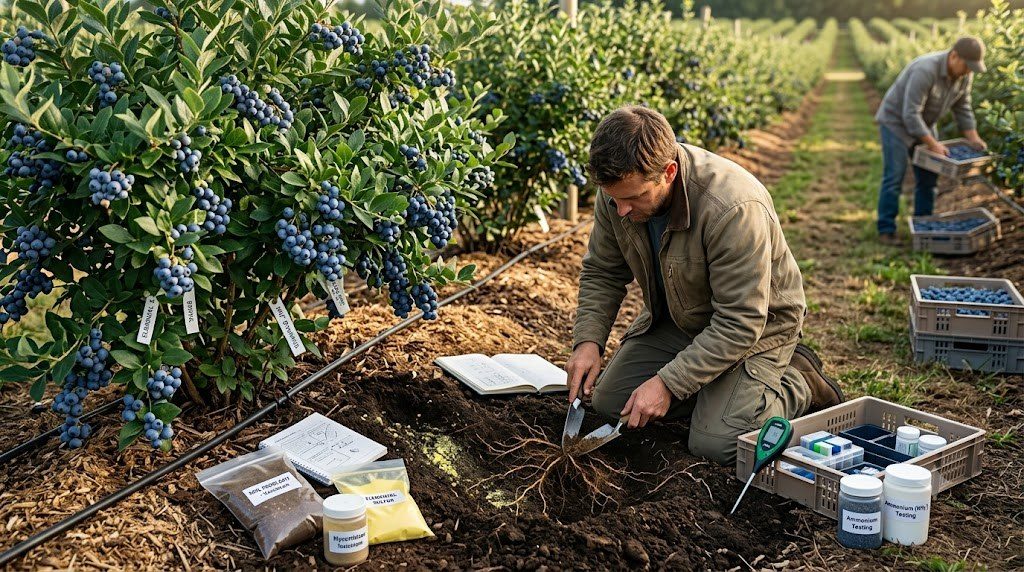
Ericaceae Soil Chemistry & Root Physiology Masterclass
An authoritative agronomic monograph on the pedological requirements of highbush and rabbiteye blueberries. We dissect elemental sulfur biological oxidation kinetics, Thiobacillus thiooxidans activity, ericoid mycorrhizal symbiosis (Rhizoscyphus ericae), ammonium vs. nitrate nitrogen metabolism, and containerized pine bark fertigation.
The blueberry (genus Vaccinium, family Ericaceae) represents one of the most commercially valuable and scientifically distinctive fruit crops in modern pomology. Native to North American acidic bogs, pine barrens, and peaty woodlands, blueberries evolved specialized physiological adaptations that diverge sharply from standard agricultural crops. Unlike rosaceous tree fruits (apples, peaches) or brassicas that thrive in neutral to slightly alkaline loams, the blueberry plant is an obligate calcifuge—thriving exclusively in strongly acidic soils characterized by high organic matter, low base saturation, and specialized nitrogen forms.
Taxonomy, Evolutionary Biogeography, and Morphological Adaptations
The genus Vaccinium encompasses over 450 species distributed across temperate, boreal, and montane tropical regions of the Northern and Southern Hemispheres. Commercial blueberry production centers upon four primary taxonomic divisions:
- Northern Highbush (Vaccinium corymbosum L.): Native to the eastern United States; cold-hardy, crown-forming shrubs reaching 1.5 to 2.5 meters in height, requiring substantial winter chilling (800 to 1,200 hours < 7.2°C) to break dormancy.
- Southern Highbush (Interspecific Hybrids): Bred by crossing V. corymbosum with native evergreen low-chill species such as the Darrow’s blueberry (V. darrowii) and rabbiteye. These cultivars require only 150 to 450 chilling hours, unlocking commercial production across warm subtropical zones like Florida, Spain, Chile, and Australia.
- Rabbiteye (Vaccinium virgatum Ait. / V. ashei): Native to the southeastern United States; vigorous, upright shrubs capable of reaching 3 to 5 meters, displaying elevated tolerance to lower organic matter, summer heat, and soil pH up to 5.6.
- Lowbush (Vaccinium angustifolium Ait.): Low-growing, rhizomatous wild shrubs forming dense carpets across glaciated barrens of Maine and eastern Canada, harvested primarily for commercial frozen processing.
Soil Chemistry Dynamics: Elemental Sulfur Oxidation & Aluminum Toxicity Windows
Commercial cultivation of blueberries—encompassing Northern Highbush (Vaccinium corymbosum), Southern Highbush (interspecific hybrids of V. corymbosum × V. darrowii), and Rabbiteye (V. virgatum)—presents unique pedological challenges due to the plant’s strict evolutionary adaptation to highly acidic, organic soils. Blueberries demand a rhizosphere pH strictly between 4.5 and 5.5 (with 4.8 to 5.2 representing the optimal physiological sweet spot). In soils with pH exceeding 5.8, blueberry plants suffer severe iron chlorosis, stunted terminal growth, and mortality.
To reduce soil pH in native neutral or slightly alkaline soils prior to planting, commercial growers incorporate agricultural elemental sulfur (S0). Elemental sulfur is not an acid itself; it requires biological oxidation by autotrophic soil bacteria, primarily Thiobacillus thiooxidans, according to the stoichiometric biochemical reaction:
2 S0 + 3 O2 + 2 H2O → 2 H2SO4 ↔ 4 H+ + 2 SO42-
Because bacterial oxidation is a temperature-dependent biological process requiring warm soil temperatures (>15°C) and adequate moisture, sulfur must be incorporated 6 to 12 months prior to field planting. However, growers must avoid over-acidification below pH 4.0: at extreme acidic thresholds, phytotoxic aluminum ions (Al3+) and manganese (Mn2+) solubilize into the soil solution, destroying root tip cellular membranes and inhibiting calcium absorption.
Nitrogen Nutrition Form: Ammonium vs. Nitrate
Unlike most agricultural crops that thrive on nitrate nitrogen (NO3–), blueberries lack functional levels of the nitrate reductase enzyme. Supplying nitrogen as calcium nitrate or sodium nitrate elevates rhizosphere pH and induces toxic leaf chlorosis. Blueberries must be fertilized exclusively with ammonium nitrogen—specifically ammonium sulfate ((NH4)2SO4) or urea—which preserves acidic rhizosphere conditions.
Ericoid Mycorrhizal Symbiosis: Rhizoscyphus ericae Mutualism
The root anatomy of the genus Vaccinium is remarkably primitive: blueberry roots completely lack root hairs. Instead, the subterranean architecture consists of ultra-fine, hair-like “hair roots” measuring less than 20 to 50 μm in diameter, with thin cell walls highly vulnerable to desiccation. In nature, blueberries compensate for this lack of absorption surface area through obligate mutualism with Ericoid Mycorrhizal Fungi (ERM), predominantly the ascomycete Rhizoscyphus ericae (formerly Hymenoscyphus ericae) and species of Oidiodendron.
ERM hyphae colonize the epidermal cells of fine hair roots, forming dense hyphal coils within individual plant cells. The extraradical hyphae extend into surrounding acidic peat and organic leaf litter, secreting acid proteases, chitinases, and phosphatases that break down complex organic matter. ERM fungi directly liberate organic nitrogen (amino acids and peptides) and organically bound phosphorus, transferring these nutrients to the host plant in exchange for photosynthetic sucrose. Furthermore, the fungal mantle protects delicate hair roots from heavy metal toxicity by sequestering excess copper and aluminum within fungal cell wall chitin.
| Blueberry Species | Ploidy | Chilling Hours (< 7.2°C) | Soil Adaptation Range | Key Commercial Strengths |
|---|---|---|---|---|
| Northern Highbush (V. corymbosum) | Tetraploid (2n=4x=48) | 800 – 1,200 Hours | Strict pH 4.5 – 5.2, High organic matter | Exceptional berry flavor, extreme winter freeze hardiness |
| Southern Highbush (Hybrid) | Tetraploid (2n=4x=48) | 150 – 400 Hours | pH 4.8 – 5.5, Tolerates pine bark beds | Ultra-early spring harvest window, low chill requirement |
| Rabbiteye (V. virgatum / ashei) | Hexaploid (2n=6x=72) | 350 – 650 Hours | Tolerates lower organic matter, pH up to 5.6 | Vigorous root system, drought and heat tolerance |
| Lowbush (V. angustifolium) | Tetraploid (2n=4x=48) | 1,000+ Hours | Acidic glacial barrens (pH 4.0 – 5.0) | Wild commercial processing, high antioxidant density |
| Half-High Hybrids | Tetraploid | 800 – 1,000 Hours | Cold climates with snow insulation | Compact stature, withstands sub-zero snowdrifts |
Aged Pine Bark Beds, Substrate Bags, and Acid Injection Fluidics
In regions where native soils possess elevated calcium carbonates or heavy clays (such as central Florida, southern Spain, or California’s San Joaquin Valley), commercial blueberry production has abandoned native in-ground planting in favor of aged pine bark beds or soilless substrate containers. Milled, aged pine bark (particle size 5 to 20 mm) provides an ideal physical matrix: high porosity (>40% air-filled porosity), superior drainage, and a natural acidic pH between 4.2 and 5.0.
However, pine bark possesses low cation exchange capacity and minimal chemical buffer capacity. Managing soilless container systems requires automated precision fertigation equipped with continuous acid injection. Industrial dosing pumps inject concentrated sulfuric acid (H2SO4) or agricultural-grade phosphoric acid (H3PO4) directly into the irrigation mainline to maintain irrigation water electrical conductivity (EC) strictly between 1.0 and 1.4 dS/m and water pH at 5.0. Delivering multiple daily pulses (5 to 10 pulses of 100 to 150 mL per container) prevents root drying while maintaining constant ammonium and iron chelate (Fe-EDDHA / Fe-DTPA) bioavailability.
Anthocyanin Pigment Profile in Vaccinium
The deep midnight-blue coloration and renowned antioxidant activity of blueberries are driven by 15 distinct anthocyanin glycosides, representing combinations of five anthocyanidins: delphinidin, cyanidin, petunidin, peonidin, and malvidin. Delphinidin and malvidin dominate the skin profile, synthesizing during the final 10 days of rapid berry ripening as chlorophyll completely degrades.
Floral Morphology, Buzz Pollination (Bombus), and Post-Harvest Rapid Pre-Cooling
The floral architecture of the genus Vaccinium is uniquely adapted to specialized entomophilous cross-pollination. Blueberry flowers are pendulous, urceolate (urn-shaped or bell-shaped) corollas with a narrow apical aperture. Within the corolla, the anthers possess terminal pores through which pollen grains must be released. Standard European honeybees (Apis mellifera) are relatively inefficient blueberry pollinators because they cannot easily enter the narrow corolla neck and cannot extract pollen from poricidal anthers without sonication.
Commercial blueberry enterprises rely fundamentally upon bumblebees (Bombus impatiens and Bombus occidentalis) and native solitary bees (such as the Southeastern blueberry bee, Habropoda laboriosa). Bumblebees execute buzz pollination (sonication): the bee grasps the pendulous flower with its mandibles and rapidly contracts its indirect flight muscles without moving its wings, generating acoustic acoustic vibrations at frequencies between 200 and 400 Hz. These acoustic shockwaves resonate through the poricidal anther tubes, violently expelling dry pollen grains directly onto the bee’s hairy thorax and sticky stigmatic surface.
Cross-pollination mediated by bumblebees dramatically enhances commercial fruit quality: cross-pollinated berries contain 30 to 60 plump seeds per fruit, developing 15% to 25% larger berry diameter, maturing 7 to 10 days earlier, and accumulating higher soluble solids (Brix) compared to self-pollinated fruit.
Following harvest, maintaining post-harvest cold chain velocity is vital to preserve berry shelf life. Blueberries must undergo forced-air pre-cooling within 2 hours of harvest to reduce internal pulp temperatures from ambient field heat (25°C to 30°C) down to 1.0°C. Operating at 0.5°C to 1.0°C with 90% to 95% relative humidity suppresses fruit respiration, preserves the natural epicuticular waxy white coating (the ‘bloom’), and prevents post-harvest rot caused by Alternaria and Colletotrichum.
Epicuticular Wax ‘Bloom’ and Vapor Pressure Deficit
The white powdery coating covering blueberries is composed of microscopically structured wax platelets. This bloom acts as a natural vapor barrier, reducing post-harvest transpirational moisture loss by over 50%. Commercial packing lines utilize gentle soft-roller grading belts to prevent rubbing off this valuable cosmetic and protective waxy barrier.
| Cultivar Class | Dominant Species | Chill Hours (<7.2°C) | Berry Size (g) | Primary Commercial Market |
|---|---|---|---|---|
| Duke (Northern Highbush) | V. corymbosum | 800 – 1,000 | 1.8 – 2.2 g | Early fresh market; machine harvestable |
| Bluecrop (Northern Highbush) | V. corymbosum | 800 – 1,000 | 1.6 – 2.0 g | Mid-season fresh and processing standard |
| Legacy (Northern/Southern) | Interspecific hybrid | 500 – 700 | 1.7 – 2.1 g | Exceptional flavor; broad climate flexibility |
| Star (Southern Highbush) | Hybrid complex | 300 – 400 | 2.0 – 2.5 g | Early fresh export; high firmness |
| Climax (Rabbiteye) | V. virgatum | 450 – 500 | 1.3 – 1.6 g | Commercial processing; heat hardy |
| Powderblue (Rabbiteye) | V. virgatum | 550 – 650 | 1.5 – 1.8 g | Late fresh table berry; crack resistant |
Structural Renewal Pruning Biomechanics and Over-The-Row Mechanical Harvesters
In mature commercial highbush blueberry plantings (year 6 and beyond), maintaining long-term fruit size and annual yield requires aggressive canopy renewal pruning executed during winter dormancy. Blueberry bushes naturally produce dozens of cane shoots originating from the crown. Individual canes follow a distinct physiological productivity lifecycle: canes reach peak fruit quality and bud density during years 3, 4, and 5. By year 6 and 7, cane bark turns gray, thick, and rough; lateral branching becomes dense and weak (‘twiggy’); and fruit size drops by over 30%.
Commercial pruning crews execute three coordinated cuts annually:
- Cane Removal at Ground Level: Every winter, crews excise the oldest, thickest, grayest canes (typically 15% to 20% of the bush’s total cane volume) right at the crown using sharp long-handled loppers or pneumatic pruners. Removing old canes opens the center of the bush to direct solar irradiance, stimulates vigorous new basal primocanes, and maintains a balanced bush composed of 8 to 12 canes of diverse ages (1 to 6 years old).
- Weak Twig Detail Thinning: Low-hanging branches originating below 40 cm are cut back to prevent fruit from touching the ground during heavy harvest loading. Clustered, weak, thin twigs inside the canopy interior are removed to focus photosynthetic assimilates into strong terminal fruiting spurs.
- Mechanical Harvester Adaptation: For commercial processing markets, bushes are harvested using high-clearance, Over-The-Row (OTR) Rotary Harvesters. These machines straddle the blueberry row. Dual rotating sway drums equipped with flexible nylon fingers vibrate the canopy horizontally at 300 to 500 RPM. Ripe berries, having formed a natural abscission layer, detach cleanly, falling onto spring-loaded catch plates that slide around the bush crowns before conveying berries to sorting blowers. Modern cultivars bred for mechanical harvesting (such as ‘Draper’ and ‘Liberty’) feature narrow, vase-shaped crowns, upright branching, and concentrated fruit ripening.
Mechanical Harvest Firmness & Bruising Indices
Mechanical harvesting can cause internal bruising in soft cultivars, accelerating post-harvest decay. Breeding programs select for firm-fleshed varieties with small, dry picking scars (the stem detachment point). Cultivars with wet, torn picking scars lose juice and are prone to rapid post-harvest mold colonization.
Iron Chelation Biogeochemistry and Foliar Urea Absorption in Ericaceae
Because the roots of Vaccinium species lack ferric chelate reductase enzyme adaptations capable of extracting iron from alkaline complexes, iron chlorosis is the primary limiting factor in non-acidic soils. In soils where pH drifts between 5.5 and 6.5, standard soil applications of iron sulfate rapidly oxidize to insoluble Fe(OH)3. Commercial growers overcome this restriction by soil-drenching high-stability Fe-EDDHA (iron ethylenediamine-N,N’-bis(2-hydroxyphenylacetic acid)) or applying foliar sprays of amino-acid-chelated iron complexes.
Furthermore, research in nitrogen assimilation demonstrates that foliar applications of low-biuret urea (at 0.5% concentration) during post-harvest summer flushes are absorbed directly through the thin leaf cuticle within 6 hours. Endogenous urease enzymes rapidly hydrolyze urea into ammonium (NH4+) inside leaf mesophyll cells, replenishing protein and amino acid reserves in perennial crowns and dormant buds without inducing root-zone pH spikes.
Agronomic Synthesis & Blueberry Production Vision
Commercial blueberry success is built from the soil upward. Achieving exact pH regulation (4.8 to 5.2) through pre-plant elemental sulfur, sustaining ericoid mycorrhizal networks with organic pine bark mulches, fertilizing exclusively with ammonium nitrogen, and managing bumblebee buzz pollination guarantees high-tonnage yields of premium, bloom-covered fruit.


