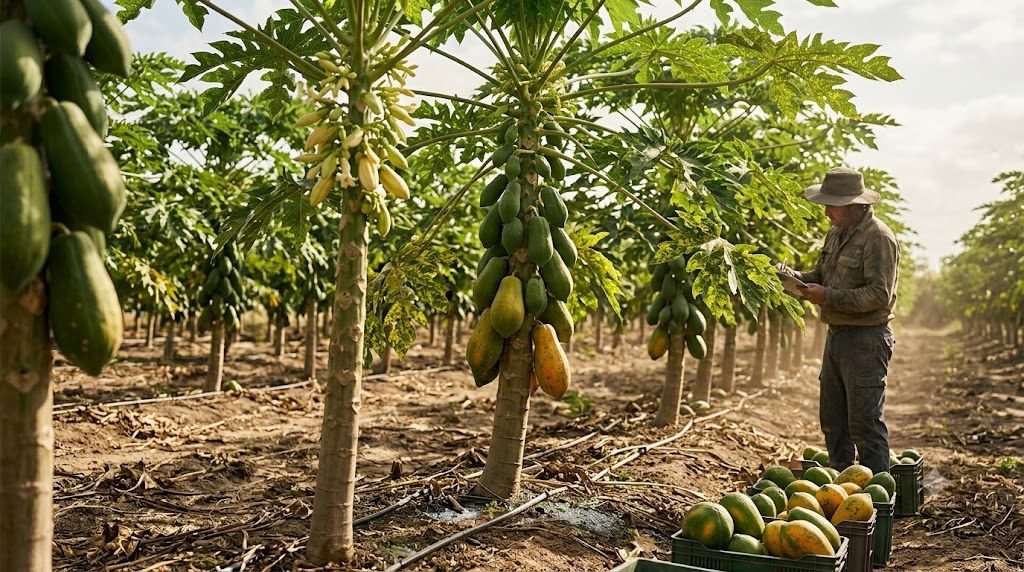
Caricaceae Genetics & Botanical Pathophysiology
A rigorous scientific investigation into the reproductive biology and agronomy of Carica papaya. We model trioecious sexual chromosome genetics, dissect Papaya Ringspot Virus epidemiology, formulate precision deficit irrigation schedules, and outline post-harvest enzyme stabilization protocols.
The papaya (Carica papaya L.), belonging to the small tropical family Caricaceae, represents one of the fastest-growing and highest-yielding fruit crops in the global tropics. Unlike typical woody dicotyledonous fruit trees that require years of vegetative juvenility before bearing, papaya is a giant, fast-growing herbaceous semi-succulent capable of initiating flowering within 4 to 6 months from seed and producing harvestable fruit within 9 to 12 months. However, this extraordinary vegetative velocity brings unique botanical complexities, notably an intricate genetic sex determination system, acute susceptibility to viral pathogens, and delicate hydraulic vulnerability.
Botanical Architecture and Monopodial Growth Habit
Carica papaya exhibits an erect, unbranched monopodial growth habit. The cylindrical trunk, capable of reaching 3 to 10 meters in height, consists of a spongy, soft, semi-woody stem containing a large central hollow pith surrounded by fibrous tissue and extensive latex-bearing vessels (laticifers). Leaves are spirally arranged along the apex of the trunk in a dense terminal crown. Each leaf is palmately lobed, featuring 7 to 11 deep lobes on prominent hollow petioles that frequently exceed 60 to 100 cm in length.
Because the main stem does not produce lateral branches under normal vegetative conditions (lateral bud break is strongly inhibited by apical dominance from the active shoot meristem), fruit is produced sequentially along the trunk at the axils of each emerging leaf. Consequently, the rate of fruit production is directly coupled to the rate of leaf emergence. A healthy papaya tree in optimal tropical conditions initiates 2 to 4 new leaves per week, supporting continuous concurrent flowering, fruit swelling, and ripening along a vertical fruiting column.
Sex Expression Genetics: Hermaphrodite vs. Female vs. Male Dimorphism
The floral biology of Carica papaya represents one of the most intriguing sexual systems in angiosperms. Papaya exhibits trioecy, characterized by three distinct sexual phenotypes: staminate (male), pistillate (female), and hermaphrodite (bisexual), governed by a single genetic locus featuring three alleles: M1 (male), M2 (hermaphrodite), and m (female). The combinations M1M1, M1M2, and M2M2 are lethal to zygotes, ensuring that all functional plants carry a recessive m allele:
- Female (mm): Bears purely pistillate flowers featuring five distinct petals and a large spherical ovary with five sessile stigmas. Without cross-pollination from hermaphrodite or male trees, fruit will not set or will yield seedless, unmarketable specimens. Female fruits are characteristically spherical with large internal seed cavities.
- Hermaphrodite (M2m): Bears perfect bisexual flowers containing both functional stamens (10 anthers) and a cylindrical ovary. Self-pollination occurs readily prior to anthesis. Hermaphrodites produce the commercially prized elongated “solo” or pyriform fruits with thicker flesh and smaller cavities.
- Male (M1m): Bears long, pendulous inflorescences bearing hundreds of staminate flowers with rudimentary, non-functional pistils; commercially non-productive.
Because seeds collected from open or self-pollinated hermaphrodites segregate in a Mendelian ratio of 2 hermaphrodites to 1 female (2 M2m : 1 mm), commercial growers plant 3 to 4 seedlings per hill. Once plants flower at 4 to 6 months of age, growers rogue out female and weak specimens, retaining exactly one vigorous hermaphrodite per planting station.
Sex Reversal Under Climatic Stress
Hermaphrodite papaya flowers exhibit phenotypic plasticity under extreme ambient temperatures. High summer heat (>35°C) paired with water stress induces carpellody (‘cat-facing’, where stamens fuse abnormally into ovaries) or complete pistil sterility (where ovaries abort, turning the flower functionally male). Precise drip irrigation and micro-sprinkler cooling mitigate sex reversal.
Papaya Ringspot Virus (PRSV) Pathogenesis, Vector Management, and Resistant Hybrids
Papaya Ringspot Virus (PRSV), a member of the genus Potyvirus, is the single most destructive agronomic disease afflicting papaya orchards globally. Transmitted non-persistently by numerous aphid species (including Aphis gossypii and Myzus persicae), PRSV infects within seconds of exploratory sap probing. Symptoms manifest as yellow vein clearing, intense mosaic mottling, leaf distortion (‘shoestring’ symptom), water-soaked dark green rings on petioles, and concentric ringspots on fruit skin.
Because aphids transmit the virus non-persistently, conventional contact insecticides fail to prevent inoculation; by the time the insect acquires a lethal insecticide dose, transmission has already occurred. Management protocols require comprehensive integrated cultural controls:
- Transgenic Resistance (Rainbow / SunUp): In Hawaii, the deployment of coat-protein gene-mediated resistance transformed the industry, conferring pathogen-derived immunity against PRSV.
- Vector Barrier Cropping: Interplanting border rows of non-host tall grasses (such as sorghum or corn) traps migrating aphids, allowing them to clean their stylets of viral particles before flying into the papaya crop.
- Rigorous Roguing & Micronutrient Fortification: Weekly inspections and immediate chainsaw roguing of early symptomatic trees prevent the orchard from becoming a regional inoculative reservoir.
| Cultivar / Line | Sex Type | Fruit Morphology | PRSV Tolerance | Brix Rating |
|---|---|---|---|---|
| Solo Sunrise | Hermaphrodite / Female | Pyriform, Red pulp (400-500g) | Highly Susceptible | 14.0 – 16.0° Bx |
| Rainbow (Transgenic) | Hermaphrodite | Pyriform, Yellow-orange pulp | Immune (CP-mediated) | 13.5 – 15.0° Bx |
| Red Lady (Tainung #4) | Hermaphrodite / Female | Oblong, Deep red pulp (1.5-2kg) | Moderately Tolerant | 12.0 – 13.5° Bx |
| Maradol | Hermaphrodite / Female | Large cylindrical, Red-orange (1.5-2.5kg) | Susceptible | 11.5 – 13.0° Bx |
| Waimanalo | Hermaphrodite | Round-pyriform, Orange-yellow pulp | Susceptible | 12.5 – 14.0° Bx |
Post-Harvest Enzyme Biochemistry: Papain Extraction and Chilling Injury Thresholds
The laticifers of green, unripe papaya fruit contain significant concentrations of papain and chymopapain, high-molecular-weight cysteine endopeptidases capable of hydrolyzing peptide bonds across a broad pH spectrum (pH 4.0 to 8.5). In commercial plantation systems, latex is harvested via controlled longitudinal scarification of green fruit with stainless steel or horn blades. The exuded latex is collected, stabilized with potassium metabisulfite, and vacuum-spray dried for industrial applications in pharmaceutical proteolysis, meat tenderization, and brewing chill-haze stabilization.
For fresh fruit export markets, temperature management post-harvest is critical. Papaya is intensely chilling-sensitive. Exposure to storage temperatures below 10°C for more than 48 hours disrupts cell membrane liquid-crystalline phase transitions, leading to electrolyte leakage, failure to ripen, surface pitting, and scald-like skin browning. Export shipments are held strictly at 12°C to 13°C at 90% to 95% relative humidity to delay ethylene climacteric peaks without triggering chilling necrosis.
Hot Water Vapor Heat Treatment (VHT) for Quarantine Disinfestation
To comply with international quarantine protocols against the Mediterranean fruit fly (Ceratitis capitata) and melon fly (Bactrocera cucurbitae), export papayas undergo hot water immersion (48°C for 20 minutes) followed by forced vapor heat treatment until fruit core temperature reaches 47.2°C. This thermal protocol sterilizes insect eggs without coagulating fruit mesocarp proteins.
Water Relations and Deficit Irrigation Fluidics in Sandy vs. Clay Loams
The hydraulic physiology of Carica papaya is exceptionally unique among arborescent crops. Because papaya possesses a soft, hollow, herbaceous, semi-succulent stem rather than lignified true hardwood, its internal xylem architecture features large-diameter vessels with high hydraulic vulnerability to cavitation. Concurrently, its expansive, palmate leaves possess high stomatal conductance, driving extreme transpirational demand under high vapor pressure deficits (VPD > 2.5 kPa).
Root development in papaya is predominantly shallow and lateral, with over 80% of active feeder roots concentrated within the upper 30 to 45 cm of soil. This superficial rooting architecture creates extreme susceptibility to both moisture stress and anoxic waterlogging:
- Sensitivity to Anoxia (Root Suffocation): In poorly drained clay soils, continuous soil saturation for as little as 24 to 36 hours depletes soil oxygen (hypoxia), triggering rapid ethylene synthesis in root tips. This leads to epinastic leaf curling, yellowing, root cortex death, and secondary invasion by oomycetes (Phytophthora palmivora and Pythium aphanidermatum). Consequently, commercial groves are planted atop raised trapezoidal mounds or continuous ridges 30 to 50 cm high.
- Regulated Deficit Irrigation (RDI): To maximize water productivity, precision automated drip systems deploy pressure-compensating inline emitters (1.6 to 2.0 L/h) spaced 50 cm apart along dual drip laterals. Scheduling irrigation based on 80% to 90% of crop evapotranspiration (ETc) during vegetative development, transitioning to mild deficit (70% ETc) during final fruit maturation, concentrates soluble sugars (fructose and sucrose) in the pulp, boosting fruit Brix by 1.5 to 2.0° Bx without reducing marketable yield.
Tensiometer Soil Moisture Monitoring
Soil moisture tension should be maintained between -15 kPa and -25 kPa at 30 cm root depth. If tensiometer readings drop below -40 kPa, stomata close prematurely, causing flower bud abortion and significant reduction in photosynthetic carbon assimilation.
Thermal Extremes and Cold-Induced Latex Gelling in Carica papaya
The geographic boundary of commercial papaya cultivation is strictly delineated by cold thermal tolerances. As an obligate herbaceous tropical perennial, Carica papaya lacks physiological mechanisms for cold acclimation or dormancy. Ambient temperatures below 15°C severely suppress root hydraulic conductivity and photosynthetic gas exchange. When temperatures drop below 10°C, stomatal aperture collapses, rubisco activity falls by over 80%, and leaf chlorosis accelerates.
Under near-freezing regimes (0°C to 4°C), intracellular ice crystals rupture the thin parenchymal cell walls of the giant leaves and hollow petiole columns. Furthermore, chilling temperatures induce latex gelling within the articulated laticifer vessels. Cold-thickened latex loses its ability to flow rapidly to wound sites, impairing the tree’s natural chemical defense mechanism against opportunistic bacterial pathogens such as Erwinia mallotivora (bacterial crown rot).
To establish commercial papaya groves in marginal subtropical zones (such as South Florida, coastal Israel, and northern India), growers implement microclimate engineering:
- Windbreak Buffers: Planting dense evergreen windbreaks (such as Casuarina or bamboo) along northern orchard boundaries deflects cold winter winds, preventing mechanical leaf shredding and chilling desiccation.
- Thermal Reflective Mulching: Installing silver-on-black or white polyethylene reflective mulches across planting beds warms root-zone temperatures by 2°C to 4°C during cool mornings, maintaining active mineral uptake through fragile feeder roots.
- Under-Tree Micro-Sprinkler Frost Protection: During radiative frost events, operating under-canopy micro-sprinklers continuously releases latent heat of fusion as water freezes on the ground (334 Joules per gram of water), raising ambient grove air temperatures by 1.5°C to 2.5°C and preventing terminal meristem death.
Latex Gelling Diagnostic Index
If stem laticifers fail to bleed clear white latex within 5 seconds of shallow epidermal incision, the tree is under severe thermal or osmotic shock. Normal latex hydrostatic pressure (typically 0.8 to 1.2 MPa in turgid plants) indicates healthy vascular conductance.
| Abiotic / Biotic Stress | Physiological Symptom | Critical Threshold | Commercial Remediation Strategy |
|---|---|---|---|
| Sub-Zero Chilling / Frost | Petiole collapse, water-soaked leaves, crown death | < 2.0°C for > 2 hours | Under-canopy sprinkler frost heating; windbreaks |
| Extreme Heat (>35°C) | Carpellody (cat-facing) & female sterility | > 36.0°C with VPD > 3.0 kPa | Overhead misting; deficit irrigation buffering |
| Soil Hypoxia / Flooding | Epinasty, lower leaf shedding, taproot rot | > 24 hours saturation | Planting on 40-50 cm raised trapezoidal ridges |
| Boron Deficiency | Bumpy fruit, latex oozing, flower drop | < 20 ppm in leaf petiole | Soil borax drench (10 kg/ha) + foliar boric acid |
| Anthracnose (Colletotrichum) | Circular sunken black spots with salmon spore masses | RH > 85% with free water | Prophylactic copper + azoxystrobin rotation |
Clonal Propagation via Epicotyl Grafting and Seed Cryopreservation Kinetics
While commercial Carica papaya production predominantly utilizes seed-derived populations, multiplying elite hermaphroditic genotypes without sexual segregation has driven the adoption of clonal epicotyl and side-cleft grafting. Juvenile seedling rootstocks (30 to 45 days old, displaying pencil-thick stems) are topped at 15 cm above ground level. Scions harvested from mature, certified disease-free hermaphrodite trees with verified superior fruit morphology and high Brix ratings are carved into precision wedges and inserted into the rootstock stem.
Maintained under high relative humidity (>90%) with plastic grafting clips, cambial reconnection establishes within 12 to 16 days with over 85% success. Clonal papaya trees eliminate the labor-intensive requirement of planting multiple seedlings per hill and roguing out undesirable female plants. Furthermore, for long-term genetic preservation, papaya seeds—which exhibit intermediate recalcitrant-orthodox storage behavior—are desiccated to 8% to 10% moisture content and cryopreserved in liquid nitrogen (-196°C) with vitrification solutions, preserving germplasm viability for decades without loss of germination vigor.
Pedological Chemistry: Nitrogen-Phosphorus-Potassium Nutrition Dynamics
Due to its continuous concurrent vegetative extension and fruit loading, Carica papaya exhibits massive nutrient uptake rates throughout its commercial lifespan. Deficiencies in major macronutrients rapidly stall leaf emergence and trigger premature flower abortion:
- Nitrogen (N): Essential for driving rapid leaf emergence and maintaining photosynthetic leaf area. However, excess nitrate nitrogen during fruit filling triggers excessive vegetative elongation, soft watery fruit flesh, and elevated susceptibility to anthracnose (Colletotrichum). Optimum leaf petiole nitrate levels should range between 1,500 and 2,500 ppm NO3-N.
- Phosphorus (P): Critical during initial root establishment and continuous floral primordia initiation. Papaya roots exhibit dense associations with vesicular-arbuscular mycorrhizal (VAM) fungi; incorporating mycorrhizal inoculants at seedling transplant enhances phosphorus bioavailability in high-iron tropical oxisols.
- Potassium (K): The dominant mineral cation in mature fruit. Potassium catalyzes sugar translocation via phloem loading, elevating total soluble solids (Brix) and reinforcing cell wall rigidity. The optimum N:K application ratio shifts dynamically from 1:1 during the initial juvenile phase to 1:1.5–1:2.0 once continuous fruit setting begins.
- Boron (B): Papaya is extraordinarily sensitive to boron deficiency. Lack of boron impairs cell wall cross-linking and pollen tube elongation, resulting in “bumpy fruit” physiological disorder (severe fruit deformation with latex exuding from surface blisters). Routine soil applications of borax or foliar boric acid sprays (0.1% to 0.2%) prevent deformity.
Agronomic Synthesis & Grower Guidelines
Managing papaya orchards requires meticulous sexual phenotyping at first anthesis, continuous aphid vector suppression, ridge cultivation to safeguard root aeration, and disciplined deficit drip irrigation to achieve premium, high-Brix market yields.


